


Archive for June, 2021
Air Quality and Lead Exposure Endanger California Children’s Health
Children in the Inland Empire Suffered Months of Poor Air Quality in 2019
Days With Unhealthy Ground-Level Ozone Concentrations in California Counties, 2019
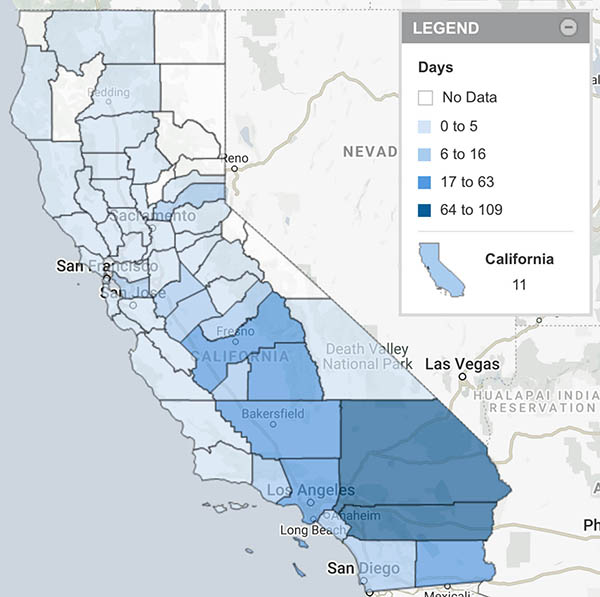
Air pollution is a serious threat to children’s health, with links to adverse birth outcomes, obesity, cardiovascular and respiratory diseases, and cancer. It can also be associated with deficits in cognitive and behavioral development.
Counties in the Inland Empire recorded the most days with
unhealthy ground-level ozone concentrations in 2019, followed by neighboring counties in Southern California and the Central Valley. Children in San Bernardino County spent nearly three out of every 10 days in 2019 with unhealthy air (109 days). Riverside County had 64 days with unhealthy air, and Tulare County had 59 days. By contrast, 15 counties did not record any unhealthy air days, and nine counties lacked data.
At Least 7,000 California Children Had Elevated Blood Lead Levels in 2018; Undercounts Obscure Magnitude of the Problem
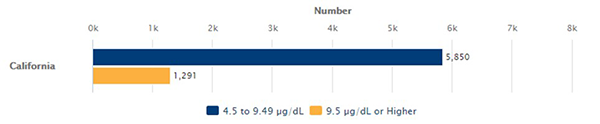
California Children Ages 0 to 5 With Elevated Blood Lead Levels, 2018
Childhood exposure to any level of lead is linked to lifelong adverse effects on physical, neurological, cognitive, academic, and economic outcomes. No amount of lead in the blood is considered safe.
In 2018, 7,141 California children ages 0 to 5 were reported to have
elevated blood levels, including 1,291 children with blood levels at 9.5 micrograms or higher. These numbers are substantial undercounts. Though state regulations require lead screening for every child enrolled in Medi-Cal, the state’s Medicaid Program, many children are not screened. Between fiscal years 2009-10 and 2017-18, fewer than 27% of Medi-Cal enrollees ages 1 to 2 received all of their required lead screenings, according to a report by the California State Auditor.
Learn more about lead poisoning.
Additional Resource
U.S. children exposed to air pollution and household lead face a higher risk of incarceration and lower incomes in adulthood, according to a new study by Robert Manduca of the University of Michigan and Robert J. Sampson of Harvard University. This research is a part of a special issue in the journal, Population and Environment, summarized
here.
Conference
Be a part of the conversation on using public data to understand our communities during this period of immense challenges arising from COVID-19 and political polarization. The conference, “Public Data: Making Sense of the New Normal,” is organized by the Association of Public Data Users and takes place July 26-29, 2021. Register here.
Recently Released Data
We recently released data about asthma and teen sexual health. See links to the latest here.
Posted by kidsdata.org
Post Comment
Nearly 10,000 Homeless Youth in California Lack Shelter
Number of Sheltered and Unsheltered Homeless Youth Ages 0 to 24 in California, 2020
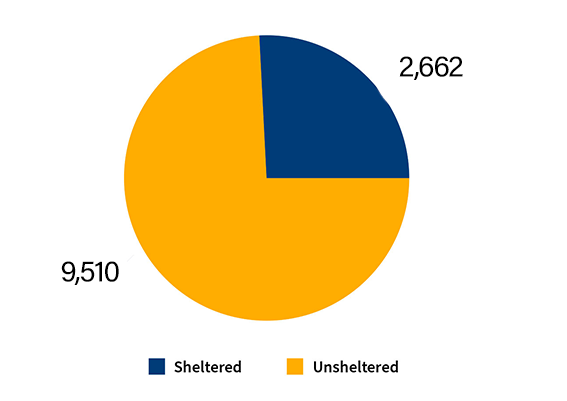
Almost 10,000 youth and young adults who are experiencing homelessness in California are unsheltered. During the January 2020 annual homelessness Point-in-Time Count, 9,510 youth ages 0 to 24 were unsheltered while an additional 2,662 youth were homeless but sheltered. These 12,000+ youth were also without a parent or guardian while homeless. Sheltered youth were counted in emergency shelters, transitional housing programs, or safe havens; unsheltered youth were staying in a place not ordinarily used for sleeping.
Los Angeles, Santa Clara, and San Francisco counties found the highest number of youth ages 0 to 24 who were homeless and unsheltered in California in January 2020.
Youth who experience homelessness are more likely than other young people to face hunger and malnutrition, physical and mental health issues, developmental delays, and academic problems.
Job Posting
PRB is hiring! Support data and administrative work on KidsData and other projects at PRB. We are looking for a full-time research assistant located in California or Washington, DC.
Read more.
Children’s Health Resources
Mapping Child Opportunity is a new, interactive map from diversitydatakids to give community leaders and policymakers tools to create conditions for all children to thrive.
Transforming Practice with HOPE (Healthy Outcomes from Positive Experiences), a new journal article in Maternal and Child Health, translates research findings about the effects of positive childhood experiences for clinical and organizational settings.
Recently Released Data
We recently released data about air quality. See links to the latest here.
Posted by kidsdata.org
Post Comment